Mandelbrot, Boyd & Musashi: Part 4 - Holographic Consciousness
“Rather, to understand consciousness is to understand and perceive that without consciousness there is no time. If time is the measurement of change, for there to be change, there must be an observation of the before and after state (the change) and without consciousness there are no observable events (or states). Think of the mind as a series of events - conscious observations. This can be seen in the observations of an electron, the observation determines if the electron is a particle or a wave…That time exists because of consciousness, without it, there is no observable time.” - Part 3-Risk
Previously in Part 3-Risk I ended with a brief discussion of consciousness and I would like to expand on that now starting with holograms. Holograms are sourced from holographic film. This film, if you were to look at it directly, would look like a piece of plastic film with ripples. These ripples are called interference patterns and are the physical representation of the images contained on the holographic film. These interference patterns look nothing like the images, the images are only seen once a laser illuminates them in all their 3D glory. An interesting property of holographic film is if you were to cut the film in half, and shoot a laser at one of the halves, it would still show the 3D image. For example, the holographic film has a 3D image of a dog and if the film is cut into two pieces, even eight pieces - all the pieces would contain the entire 3D image of the dog (with the dog becoming more pixelated as you cut the film into smaller and smaller pieces).These smaller pieces contain the same information as the whole piece of holographic film. The information is distributed nonlocally, just as at the quantum level we get nonlocality.
Physicist David Bohm noticed that these interference patterns on holographic film appear disordered when looked at directly, but then appear ordered when viewed with a laser. The order of the images is hidden or enfolded. This concept of enfolding is how Bohm described our reality: the electron (any particle really) can manifest as either a particle or a wave with both being enfolded in the quantum ensemble (the hidden reality). When observed the quantum ensemble determines which (particle or wave) unfolds into our physical reality. The interference patterns on a holographic film mimic the quanta, the subatomic particles that are somehow both a particle and a wave - until observed where they manifest as one or the other (or are they both and the observer is only aware of one like a lenticular sticker?). This enfolding and unfolding process is very much like the properties of interference patterns on holographic film as they react to illumination by a laser.
If the universe is a holograph, then consciousness is the laser. Consciousness renders the data and as such consciousness can manipulate the presentation of the data. Implying that consciousness exists in all matter or potentially as panpsychism followers believe, that all matter is conscious. The rendering of the data by consciousness frames reality as a computational construct. What does that mean exactly?
The universe is information. Information is the basis, not matter, in the creation of our physical reality. That information is represented by a data stream that contains every piece of information that has ever existed. This data stream of information is tapped into by consciousness and then projected (just like a 3D hologram) into our physical reality. Every individual, possessing consciousness or rather being consciousness, perceives information differently to where the physical reality is perceived differently by all. Almost to where each individual lives in their own reality. It is only the shared interpretation of information that makes the physical reality the same for all individuals (observers). So, when information manifests into a desk, because we share the same interpretation or definition of that particular piece of information we both observe a desk. We are all players in the Matrix.
Awareness of the data stream contributes to the ability to observe, orient, decide, and act (OODA Loop) on that information. This is also known as being in the zone. Being in the zone is to break through our perception filters and see the true state of things. I have often thought that this was something one could not force and that it came from years of training combined with serendipity and it would eventually occur. I am coming around to the line of thinking that while being in the zone is not an off/on switch, it can be better predicted by understanding that awareness of the data stream is really about being in the same plane as that data steam. In other words, one is operating at the same tempo as the data stream (as the visualization below shows).
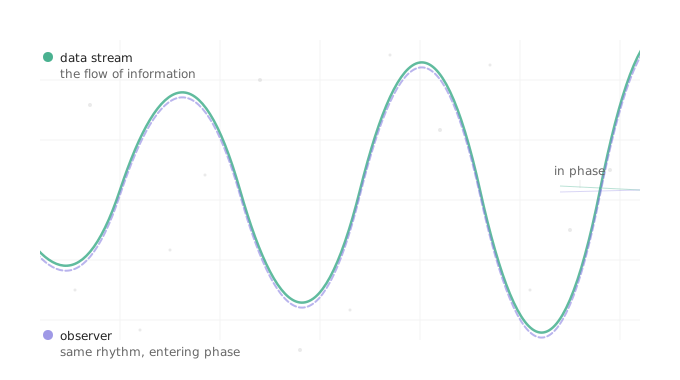
Rhythm Sync: Data and observer are rhythmically synced (generated with Claude Sonnet 4.6)
Perhaps, the observer is operating at the same rhythm as the data but able to move faster: this is (faster) tempo. The observer is able to operate at a faster tempo than the data, gaining the ability to anticipate where the data will move to. The observer is able to operate inside the OODA loop of the data stream, predicting the outcome and moving accordingly. This is the act of skating to where the puck will be.
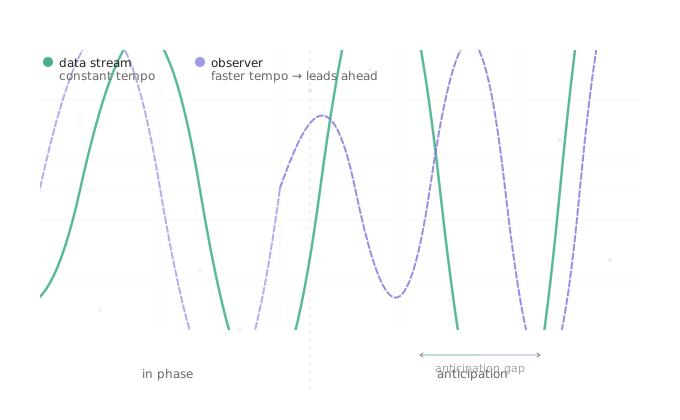
Faster Tempo: The observer is now slightly ahead at a faster tempo than the data stream (generated with Claude Sonnet 4.6)
In Part 1-Fractals I discussed Boyd’s fast transients and Musashi’s insights on understanding an opponent’s rhythm. The visualizations above illustrate the explicit: operating at a faster tempo is not merely an advantage in a confrontation (or light saber dual), it is a fundamental relationship with the data stream itself. Before outpacing the opponent’s decision cycle, one must synchronize with the information environment. The wave animations above first show the observer entering the same plane as the data followed by (the most crucial change) the observer compressing their own tempo to move slightly ahead of the data stream.
This also relates back to Mandelbrot’s time-deformation, where the compression (or stretching) of the time axis distorts perception. When the observer compresses their own tempo, they are in effect performing a deliberate time-deformation. The Faster Tempo wave animations suggest that the deformation is not necessarily something that happens to an observer, but it can be something the observer initiates.
Continuing this train of thought into Part 3-Risk where I discussed capacity. As a reminder, a football team that has built capacity has a greater ability to experience the events transpiring on the field, understand those events, and then adapt. The demonstration of this kind of capacity is illustrated in the Faster Tempo wave animation above where the observer compresses their tempo and pulls ahead of the data stream. Being in the zone, then, is reliant on the act of perceiving. For without perceiving one cannot adapt and therefore cannot build capacity.
The Faster Tempo wave animation is essentially a picture of the process of the mind measuring time through the observation of the present, cataloguing event to inform and predict.
Is the wave animation representative of consciousness itself? I would argue it is more an illustration of the process of consciousness acting on the information. If observation determines if the electron is a particle or a wave, then consciousness is actively shaping observable reality. Even if the electron is both a particle and wave at the same time and it is merely the observer’s rendering of reality that “sees” one or the other. As Bohr stated, the electrons (or radiation) as particles or waves can be complementary descriptions of the same reality.(Heisenberg, 1958, 17). Further, if the universe is merely information, then consciousness is the projector (or laser) and the observer wave is a visual representation of consciousness engaging with reality or rather consciousness rendering reality into the unique view of the observer. Not just observable reality, but the unobservable as well: all data.
The idea of “all data” is supported by the concept of thin slicing where the subconscious processes through thousands of pieces of data points and produces relevant data to make decisions. The rapid processing of data by System One so that we can successfully navigate a busy intersection or anticipate the trajectory of a football in order to catch it.
When I think of being able to operate at a faster tempo than the data stream, I think of tapping into the source code of consciousness. You move from merely not just observing the presentation of the data as the reality around you, but fundamentally are able to perceive the computational construct itself: the matrix code.
Every fragment of the hologram contains the whole image. Just as branches of trees appear to be trees in the self-similarity of fractals - the parts echo the whole. If the universe is information and that information is represented as a data stream that is tapped into by consciousness, and a portion of that data is projected into the perceived reality then fundamentally, every observer, every person’s reality is fractal-like. A partial but self-similar rendering of the whole.
The observer, in phase with the data stream, and then moving ahead of it, increases the resolution of their fragment of the hologram.
If every individual observes a partial self-similar rendering of the whole, then it is likely that each observation is influenced by each individual’s personal attributes and their specific perception filters (some innate and some learned through experience). These individualized factors will influence the level of resolution of the fragment observed.
Consider someone who was raised during a time of increased turbulence economically, politically, and socially where they develop an eye for seeing the turbulent, the disruptive in the data stream. They are more likely to attach this perception filter to their observed reality seeing emerging events as having more turbulent outcomes as compared to someone who lacked this experience and thus filter.
Amplify this across millions and billions of observers yields nearly a countless number of variations of the rendering of the data stream. The implication is that variations in the partial self-similar rendering of the whole are not necessarily errors in the perception of the data stream and thus the rendering of reality, but merely different observation points tuned to different perception frequencies.
Years ago, I instructed dissimilar air combat tactics (non-maneuvering aircraft vs maneuvering aircraft). Something that I gleamed from those air-to-air engagements was that the slower or more limited one’s aircraft was capable of maneuvering against a more agile, faster opponent the exponential increase in the need to process, understand, and act on the data stream. This is hard to do when your opponent is operating at a faster tempo than you are. Where just getting into the same dimensional plane, same rhythm requires processing data faster, but also the ability to maneuver fast enough to have the opponent’s action not completely negate your decision. When in a dissimilar configuration where the technical ability does not exist to speed up the act of maneuvering, yields the need to think a step or two ahead of the data stream.
This is really hard when you only have one observation of the rendered whole to pull from. This is where harnessing other observations to increase the resolution of the rendering greatly improves the odds. By taking in multiple observations, and synthesizing them, the resolution of the fragment of the hologram is increased. The self-similarity fractal is built upon giving a more complete picture of the data. The holy grail is being able to combine these observations, to include the opponent’s observations, into a consolidated view that places one at a faster tempo (and in rhythm).
The better the observer’s filtering, the higher the resolution, the further ahead they can anticipate. Resolution and anticipation are not independent. I express the anticipation horizon as $\tau$ = $f(\rho)$
John Archibald Wheeler spoke about it from bit, where every particle, every field to include spacetime derived its existence from answering yes-or-no questions or put simply existed from information (Wheeler, 1990, 5). If the universe is information, then Mandelbrot’s time-deformation, time bunched into irregular spaced segments, is consciousness encountering the uneven distribution of information across the fourth dimension. This encounter renders uneven reality into the physical.
The data stream function, D(t), exists as an information substrate prior to any observer rendering is based off Wheeler’s theories.
Therefore, if physical states do not exist in absolute terms but relative to an observing system as Carlo Rovelli talks about. Then every observer, through consciousness, projects a render of the data stream that is partial, self-similar, and unique. The individual observer’s fractal-like projection of the total information flow is their perceived reality. As such, their situational awareness is the level of resolution they are able to perceive of their fragment of the hologram.
Remain calm and carry on, for while your rendering of reality may be filtered toward instability, there is another whose reality filter is calibrated toward calm. It is all relative.
When we interact with others, and they seem to not be present in the moment, we say their mind is elsewhere, and they lack situational awareness. In fact, what we are really saying is that the fidelity of their projection (the resolution) is quite low. If on the other hand the individual has very high situational awareness, the fidelity of their projection is quite high. This individual has compressed their tempo to pull ahead of the data stream in anticipation of the next state of reality before it is rendered. This is not instinct, nor serendipity. This is consciousness, calibrated. Poor calibration leads to a distorted view of reality. Does that make the distorted reality wrong? No, because it is that observer’s reality.
Observation is a disturbance; one cannot passively witness and the action of observation changes what is being looked at. The desire to view an electron by using a wavelength of x-ray to “illuminate” the electron will create a disturbance. One light quantum of a x-ray will push the electron and this movement will be observed. The resulting measurement does not prove that electrons move, only that at the time of observation it was observed in motion and this motion could be measured (Heisenberg, 21-22). The act of hitting the electron with the light quantum of a x-ray collapses other possibilities.
A distorted reality of one observer is not wrong as it shares the same raw data stream of another observer. The raw data stream is pure potential, all the possibilities, and each observer, in the act of observing is taking a snapshot, a measurement, of the stream. When the observers do this, they collapse the possibilities and an inference is drawn, rendering one interpretation of many possibilities. Therefore, neither observer is wrong, they are just performing different measurements on the same underlying data stream. You measure in inches and I measure in centimeters. These things can both be true at the same time.
Each observer will produce a measurement based on the quality of their observation. The quality of their observation will depend on the level of filtering, framing, questions asked, biases, historical observations (experiences), and ego (multiplicative effect on the interpretation of data). Reality, in decision cycle context, is not fully determined until an observer interacts with it, and that interaction shapes the outcome.
Where do we go from here? That vector is not clear to me right now. For now, I plan to expand on these thoughts by working towards mathematical treatment to describe the observer’s relationship with the decision cycle.
**All this is counter to a realist viewpoint of where reality (nature) is independent of consciousness. The idea of things having strongly-objective existence independent of conscious observation would not be compatible with everything I have discussed here (Kastrup, 26). For a realist would likely argue that there can only be one true reality and any observer interpretation is nothing more than just that. This implies a deterministic nature to reality, one where observer observations and inputs are independent to the data stream. How can this be true? This implies that the cause-and-effect are already pre-determined. The answer to everything is probably not 42. It is more likely the statement: these things can both be true at the same time.
__________
Anthropic. “Rhythm Sync” and “Faster Tempo.” SVG animations generated by Claude Sonnet 4.6. Claude.ai, April 5, 2026. https://claude.ai.
Kastrup, Bernardo. 2011. Meaning in Absurdity. United Kingdom: IFF Books.
Heisenberg, Werner. 1958. Physics & Philosophy. New York: Harper Perennial.
Lindberg, Christine, Stevenson, Angus, ed. 2010. The New Oxford American Dictionary, 3rd ed. New York: Oxford University Press.
Rovelli, Carlo. 2017. The Order of Time. trans. Simon Carnell, Erica Segre. New York: Riverhead Books.
Wheeler, John Archibald. 1990. “Information, Physics, Quantum: The Search for Links.” In Complexity, Entropy, and the Physics of Information, edited by Wojciech H. Zurek, 3–28. Redwood City, CA: Addison-Wesley.
__________
© 2026 Jeremy Reynolds, all rights reserved.
Back to Blog Index
perceptions